Thursday, January 28, 2016

Dutch Masters - Landscapes of Aert van der Neer

When it comes to Dutch landscapes there is one artist that predominantly comes to my mind: Aert van der Neer. 

Moody, sombre, bleak and bare; Aert van der Neer captures the imagination with autumnal and wintry landscape scenes and figures with contrasting animation against the backdrop of a blustery and cold setting.

Born in 1603 and deceased in 1677 Aert van der Neer mostly lived a life of complete obscurity and poverty although he was a contemporary of more famous artists such as Albert Cuyp and Mendert Hobbema in an age that has been described as the Golden Age of Dutch painting. It was not until after his death that his sombre landscapes and settings became a source of inspiration for the great painters of the romantic movement in the latter 18th century. Aert van der Neer died in Amsterdam penniless and his paintings were deemed unwanted as an artist born with an artistic vision that was much ahead of his time. Note the sombre melancholy in the artists eyes through his masterful renditions of nocturnal scenes juxtaposed with glimmers of hope through the artists view of a lively humanity that sparkles into life set against a background of a wintry mood.

Collection of oil on wood panel board paintings:


Landscape with Windmill c.1647 Aert van der Neer - Hermitage Museum


Moonlit Landscape with a View of the New Amstel River
and Castle Kostverloren c.1649 Aert van der Neer - Getty Center


Moonlit Landscape with Bridge c.1650 Aert van der Neer -  National Gallery of Art, Washington D.C.


Riviergezicht bij winter c. 1655 - Aert van der Neer - Rijksmuseum Amsterdam


Winter Landscape c.1660 Aert van der Neer - Gemäldegalerie Berlin


Frozen River at Sunset c.1662 Aert van der Neer - Private Collection


River Lanscape c.1663 Aert van der Neer - Gemäldegalerie, Berlin


Aert van der Neer may not have captured the imagination of his contemporaries but his wonderful use of neutral colors in contrast with flickers of yellow and balance of shade with light bears all the tinges and hallmarks of the creative genius of a much more famous successor; the wilder and unwieldy JMW Turner himself, leading the passionate revolt against the organized pastoral blandness of his age. Truly the critics of the Dutch Golden Age had sorely missed the creativity of an under-estimated genius in the guise of the impoverished artist Aert van der Neer. Witness the birth of the argument of art for art's sake crying out for individuality against conformity. For Aert van der Neer there has always been something magical about sunsets and sunrises as points in time where events should commence to unfold or close upon us. All Time is broken down into these two chapters of nature and life. Herein, the under-estimated master combines the use of shades of murky brown and dull grey contrasting greatly and effectively with the foreground subject matter of figures that seem to become even larger than life itself in spirit on wooden panel. Drawn to the chill of nature Aert van der Neer sketches the continuity of life oblivious to the seasonal changes. Although unsuccessful in life later artists could become impressed with the Dutch master's astuteness of finding excitement among common themes. Aert van der Neer would always be remembered for his soul searching on canvas and his attempt to portray life within the enveloping darkness of nature at it's bleakest. An underlying Romantic tone can almost be discerned as the artist masterfully combines the powerful emotions of sadness with joy to render his natural landscapes with deeper thoughtful reflections on the vagaries of all life. Ahead in time; unrecognized in the present; the lofty sentiment of the artist could only choose to create from a vision untainted by the need to conform even should it mean a road towards abject poverty and a lonely destination in his lifetime.


Discussions in fine art by Pieter Bergli

For my readers that enjoy a cafe and something to read please turn to my other blog -

http://thegenteelworldofcoffee.blogspot.com/

and of course for lovers of art

https://www.pinterest.com/myartmusings/


and for readings in history there is my writings on the histories of the Napoleonic campaigns at

http://austerlitz-borodino-waterloo.blogspot.com/ 

Thank you

Monday, December 21, 2015

The March of the Seasons on Canvas

Side by side mankind dwells among rock and stone and tree for thousands of years. An Industrial revolution and technological progress a mere one hundred years later and the very fabric of our defined relationship with nature comes under threat with the march of concrete, oil, plastic and steel. Yet, within the smog of our own evolution, there is still hope, as conservation attempts to turn the tides and artists turn back and dwell upon the sanctity of our rustic origins.

Celebrate the natural landscapes of artist Jean-Marc Janiaczyk who casts his oils over canvas with sombre reflection over his native Provence, in the south of France. Art is but an imitation of life according to the ancient Greek philosopher Aristotle. nevertheless, art takes upon itself a life of it's very own as colors of shape and form take up the semblance of it's own soul.

Far from the madness of the industrial  north of France lies a whole different world of timeless beauty.


Peach trees in Spring by Jean-Marc Janiaczyk


There is a magic about Provence that almost captures the soul of rustic France and entrances both native and traveler alike.


The Country House near the Lavender by Jean-Marc Janiaczyk


The turbulent Gaulic history of bloodshed soon pacified the marching Roman legions to embrace this region's idylic beauty. A land trampled in blood whence tree and flower rose with peaceful embrace.


Orchard in flowers by Jean-Marc Janiaczyk

Mountains and shores with warm southern Mediterranean charms await those in search of a slower pace of life and rich solitude.


Summer Sunset by Jean-Marc Janiaczyk


Bouillabaisse,  the signature dish of Marseille or Raviolis à la daube, for the common man, washed down with Rosé wines and Calissons d'Aix, remind us of the colorful bliss of a retreat far from our dark urban sprawls.


Archway Fountain by Jean-Marc Janiaczyk


The words of Émile Zola and the colors of Paul Cézanne lilting with every footstep behind every corner shadow and turn to remind us of the magical air of a place where many had come to call their home.


For my readers that enjoy a cafe and something to read please turn to my other blog -

http://thegenteelworldofcoffee.blogspot.com/

and of course for lovers of art

https://www.pinterest.com/myartmusings/


and for readings in history there is my writings on the histories of the Napoleonic campaigns at

http://austerlitz-borodino-waterloo.blogspot.com/ 


Thank you

yours sincerely

Pieter Bergli


Wednesday, November 11, 2015

Astonishing sale of 'Nu Couche' - Amedeo Clemente Modigliani

Absolutely astonishing! In fact in pre-auction setting the bid was already at $100 million to the enthusiasm of Christie's. Eventually Nu Couche by Italian painter and sculptor Amedeo Clemente Modigliani, was sold for a staggering $170.4 million and became the second highest painting ever sold at auction after the Piccaso - Le Femme d'Alger which fetched $179m earlier this year.


Amedeo Clemente Modigliani b.1884 – d.1920 was born in Livorno, Italy. The Italian painter and sculptor was made famous for his several nudes. His early childhood was marred by the ruin of his father's business but his mother encouraged his precocious flair for art as a child. whilst in Rome at the age of 17 years, the young Modigliani became influenced by the great french Impressionist movement. Thus the young Modigliani knew he must go to Paris, the center of the modern art world. Although, working mostly in France, his works were frowned upon during his life, his works of the human figure in painting and sculpture became very popular in the 1930's after his early death.

The painting Nu Couche, composed in 1917-18, was purchased at the Christie's auction by Chinese billionaire Liu Yiqian who made a fortune in the stock market in the 1980's.

For my readers that enjoy a cafe and something to read please turn to my other blog -

http://thegenteelworldofcoffee.blogspot.com/

and of course for lovers of art

https://www.pinterest.com/myartmusings/

 
Thank you

yours sincerely

Pieter Bergli


Tuesday, November 3, 2015

Fine Art Auction of Impressionist Work

There's 47 lots available for the evening sale at Sotheby's on the 5th of November and the mood is buoyant with the US thanksgiving just around the corner and an US economy in full swing trying to shine the light ahead for the rest of the global economy.

Fine art is collectible not only because it is evocative and take's the viewer through an emotional experience but also because it is an investment that can grow in time particularly when world economies are growing and people find themselves with more disposable income to invest. Yes, just as people buy stocks there are people who make choice decisions of building a portfolio of rare collectibles for financial investment. So the world of art can be said to be of no less importance as a financial market than a stock market in this sense.

Sotheby's of course carry a distinguished name and the setting for an auction takes a whole lot of work. in terms of preparation there are decisions made over the shape of the theme event; then there is the identification of possible sales targets and then the gathering of a portfolio and all the marketing to be done to make up for a lively and consummate event.

Watch for a lively activity and bids on the lower end of the price range under 10m USD.

Two pieces caught my eye.

At the upcoming event watch out for Lot 2 and the idiosyncratic Marc Chagall and the 1927-28 'L'Homme au Parapluie' -  'Man with Umbrella' with Chagall's excitement for circus pageantry on canvas.


And this piece at Lot 5 by René Magritte has certainly caught my eye. It is the 1955 work 'Le Maitre D'ecole' 'School Master' and i think this piece shall see some very lively interest.


In any case there should be quite a stir as Impressionist auctions tend to attract a lot of interest.


Discussions in fine art by Pieter Bergli

For my readers that enjoy a cafe and something to read please turn to my other blog -

http://thegenteelworldofcoffee.blogspot.com/

and of course for lovers of art

https://www.pinterest.com/myartmusings/

 
Thank you

Sunday, November 1, 2015

The Windswept Moors of Wuthering Heights


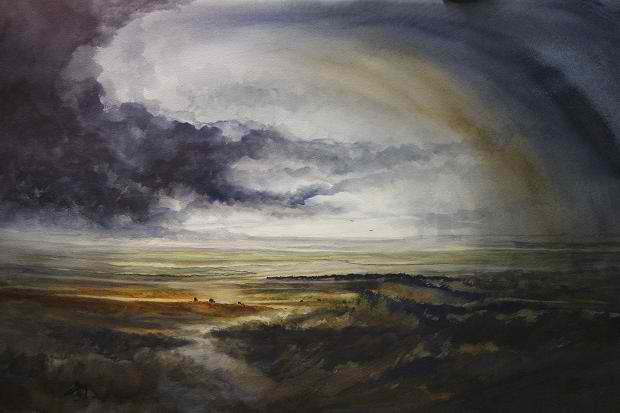
The Yorkshire Moors are cold and desolate. It's windswept moors stretch bleak and bare across the North East of England. Wuthering Heights is the story of a consuming love whose spirit was born to roam the vast emptiness of a native land and sky. Emily Bronte, the 19th century author, captures that vast emptiness of a love forlorn that neither darkened shadow of turf and shrub or tree, or the nebulous clouds that threaten and menacingly roll on, can ever match. In the classic novel the full depths and expansiveness of human emotion are explored between the extremes of Love and Hatred. 

The Yorkshire Moors offer little solace to the outsider; but for one born of the desolate land it's very emptiness nurtures the depths of the soul with the expansiveness of the infinite. Even in the emptiness one may find love. But how infinitely more empty is the tale of a love that becomes lost! Dark and brooding, Heathcliff cuts a solitary figure within an isolation, self-imposed and more empty than the vast lands that once enveloped the story of his love for Catherine Earnshaw. 


Captured in canvas are some of those bleak and brooding reflections of the Yorkshire Moors that inspired the heights of passion in the tale of Wuthering Heights. The story revolves around the life of Heathcliff, a man of assumed gypsy origin, from his childhood of seven years of age in the 1770's till the end of his life in his late thirties. It is a story of revenge. Through hard work Heathcliff rises through his adopted family, the Earnshaws, and then is reduced to servant-hood after the death of his kind patron Mr Earnshaw a mere three years after his arrival. Heathcliff runs away from his misery at Wuthering Heights when the woman he loves, Catherine Earnshaw, decides to marry another more wealthy man, Edgar Linton around 1783. In 1784 catherine develops a fever and dies after bearing a daughter, the young Catherine. Heathcliff returns later to Wuthering Heights as a rich man and sets about a plot to ruin the two families that robbed him of his love. He lends money to the drunken Linton fully knowing that the man will never repay him. Thereafter he marries the sister Isabella Linton to inherit the property of Thrushcross Grange and reduce the woman to a life of cruelty and despair out of hatred for Catherine and Edgar. Isabella runs away to London and gives birth to a son of Heathcliff. Isabella dies and the son returns home only to be treated severely. By chance one day on the moors the young Catherine comes across Heathcliff. after the death of Edgar Heathcliff controls both Wuthering heights and Thrushcross Grange. His revenge is now complete; he forces the now impoverished but beautiful young Catherine to a life of despondent servitude forcing her to live at Wuthering Heights. Heathcliff dies in 1802 and the younger Catherine finds freedom in love.


Yorkshire Moors - Harold Hopps


Excerpt - Chapter 3

I muttered, knocking my knuckles through the glass, and stretching an arm out to seize the importunate branch; instead of which, my fingers closed on the fingers of a little, ice-cold hand! The intense horror of nightmare came over me: I tried to draw back my arm, but the hand clung to it, and a most melancholy voice sobbed, 'Let me in—let me in!' 'Who are you?' I asked, struggling, meanwhile, to disengage myself. 'Catherine Linton,' it replied, shiveringly (why did I think of Linton? I had read Earnshaw twenty times for Linton) 'I'm come home: I'd lost my way on the moor!' As it spoke, I discerned, obscurely, a child's face looking through the window. Terror made me cruel; and, finding it useless to attempt shaking the creature off, I pulled its wrist on to the broken pane, and rubbed it to and fro till the blood ran down and soaked the bedclothes: still it wailed, 'Let me in!' and maintaine its tenacious gripe, almost maddening me with fear. 'How can I!' I said at length. 'Let me go, if you want me to let you in!' The fingers relaxed, I snatched mine through the hole, hurriedly piled the books up in a pyramid against it, and stopped my ears to exclude the lamentable prayer. I seemed to keep them closed above a quarter of an hour; yet, the instant I listened again, there was the doleful cry moaning on! 'Begone!' I shouted. 'I'll never let you in, not if you beg for twenty years.' 'It is twenty years,' mourned the voice: 'twenty years. I've been a waif for twenty years!'


Summer Colours in Farndale - Jim Wright


Excerpt - Chapter 9

'This is nothing,' cried she: 'I was only going to say that heaven did not seem to be my home; and I broke my heart with weeping to come back to earth; and the angels were so angry that they flung me out into the middle of the heath on the top of Wuthering Heights; where I woke sobbing for joy. That will do to explain my secret, as well as the other. I've no more business to marry Edgar Linton than I have to be in heaven; and if the wicked man in there had not brought Heathcliff so low, I shouldn't have thought of it. It would degrade me to marry Heathcliff now; so he shall never know how I love him: and that, not because he's handsome, Nelly, but because he's more myself than I am. Whatever our souls are made of, his and mine are the same; and Linton's is as different as a moonbeam from lightning, or frost from fire.'


The Spirit Moves - Ashley Jackson


Excerpt - Chapter 9

I think that's the worst motive you've given yet for being the wife of young Linton.'

'It is not,' retorted she; 'it is the best! The others were the satisfaction of my whims: and for Edgar's sake, too, to satisfy him. This is for the sake of one who comprehends in his person my feelings to Edgar and myself. I cannot express it; but surely you and everybody have a notion that there is or should be an existence of yours beyond you. What were the use of my creation, if I were entirely contained here? My great miseries in this world have been Heathcliff's miseries, and I watched and felt each from the beginning: my great thought in living is himself. If all else perished, and he remained, I should still continue to be; and if all else remained, and he were annihilated, the universe would turn to a mighty stranger: I should not seem a part of it.—My love for Linton is like the foliage in the woods: time will change it, I'm well aware, as winter changes the trees. My love for Heathcliff resembles the eternal rocks beneath: a source of little visible delight, but necessary. Nelly, I am Heathcliff! He's always, always in my mind: not as a pleasure, any more than I am always a pleasure to myself, but as my own being. So don't talk of our separation again: it is impracticable...'


Yorkshire Moors - Ashley Jackson


Excerpt - Chapter 15

'You teach me now how cruel you've been—cruel and false. Why did you despise me? Why did you betray your own heart, Cathy? I have not one word of comfort. You deserve this. You have killed yourself. Yes, you may kiss me, and cry; and wring out my kisses and tears: they'll blight you—they'll damn you. You loved me—then what right had you to leave me? What right—answer me—for the poor fancy you felt for Linton? Because misery and degradation, and death, and nothing that God or Satan could inflict would have parted us, you, of your own will, did it. I have not broken your heart—you have broken it; and in breaking it, you have broken mine. So much the worse for me that I am strong. Do I want to live? What kind of living will it be when you—oh, God! would you like to live with your soul in the grave?'

'Let me alone. Let me alone,' sobbed Catherine. 'If I’ve done wrong, I'm dying for it. It is enough! You left me too: but I won't upbraid you! I forgive you. Forgive me!'

'It is hard to forgive, and to look at those eyes, and feel those wasted hands,' he answered. 'Kiss me again; and don’t let me see your eyes! I forgive what you have done to me. I love my murderer—but yours! How can I?'


Deserted Cottage on the Yorkshire Moors - Sheila Fell


Excerpt - Chapter 33

"…for what is not connected with her to me? and what does not recall her? I cannot look down to this floor, but her features are shaped in the flags! In every cloud, in every tree—filling the air at night, and caught by glimpses in every object by day—I am surrounded with her image! The most ordinary faces of men and women—my own features—mock me with a resemblance. The entire world is a dreadful collection of memoranda that she did exist, and that I have lost her!"


Yorkshire Dales - Steven Cronin

There is a thin divide between Love and Hatred. How fast does Love consume and transform into Hatred only to turn back once again into a more elevated feeling of Love? The force of Love may ravage the heart with passion but eventually the experience elevates the soul when one dies a hundred deaths before one eventually dies.


Discussions in Literature and Art by Pieter Bergli

For my readers that enjoy a cafe and something to read please turn to my other blog -

http://thegenteelworldofcoffee.blogspot.com/

and of course for lovers of art

https://www.pinterest.com/myartmusings/

 
Thank you


Wednesday, October 28, 2015

Marc Chagall on Color

Marc Zakharovich Chagall  b. 1887 d. March 1985, Russian born French artist and pioneer of European modern art. Select quotations:


“In our life there is a single color, as on an artist palette which provides the meaning of life and art. It is the color of love.”


Pink Lovers - 1916

“In the arts, as in life, everything is possible provided it is based on love.”


Old Woman with a Ball of Yarn - 1906


“You could wonder for hours what flowers mean, but for me, they're life itself, in all its happy brilliance. We couldn't do with out flowers. Flowers help you forget life's tragedies.”


Nu aux Fleurs - 1911


“Color is all. When color is right, form is right. Color is everything, color is vibration like music; everything is vibration.”


Paris through the Window - 1913


“Love and fantasy, go hand in hand.”


Wedding - 1918

“If I create from the heart, nearly everything works; if from the head, almost nothing.”


La Danse - 1928


Creative thoughts in fine art by Pieter Bergli

For my readers that enjoy a cafe and something to read please turn to my other blog -

http://thegenteelworldofcoffee.blogspot.com/

and of course for lovers of art

https://www.pinterest.com/myartmusings/

 
Thank you

Monday, October 19, 2015

Private Art Sales - Baroque, Renaissance to Impressionist


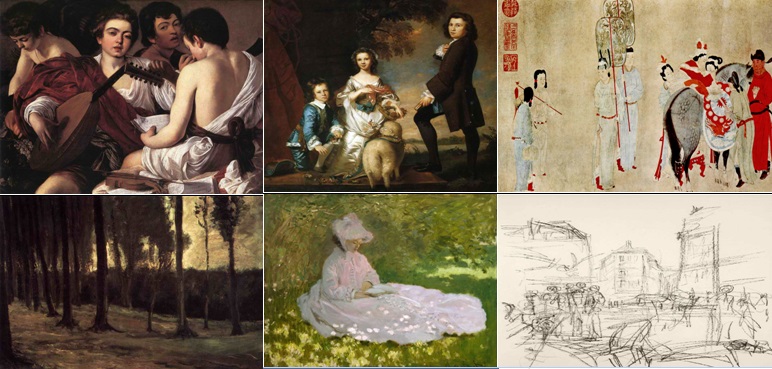
Private art sales on offer from private collections. Carianni, Caravaggio to Monet and Klee. All works are strictly in private ownership and not available for auction. Discreet inquiries are welcome only for proven buyers: 


Contact - pieter.monolith@yahoo.com

All viewings are in Europe only through strict appointment and letters of  invitation of buyer and valuer in attendance only at private showing.


Thank you,

Yours sincerely

Pieter Bergli - Fine art sales.