Tuesday, March 1, 2016

Dutch Masters - Landscapes of Aelbert Cuyp

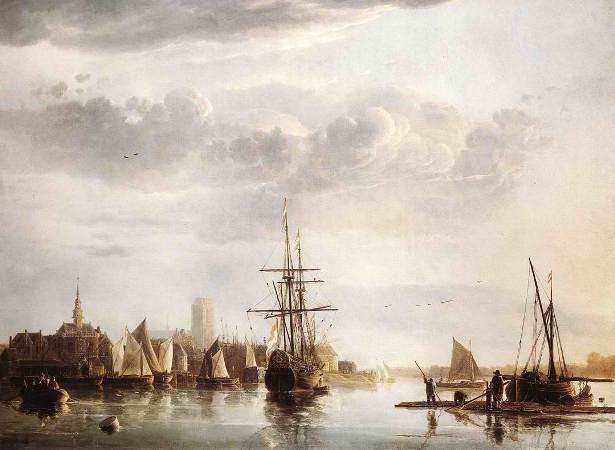
The Dutch Golden Age of the 17th century brought great wealth to the Netherlands with trade and commerce from the orient to the west. Formerly a client state of the Holy Roman Empire the new Dutch state shook off its yoke in 1590 and embarked upon an ambitious global trading policy that eventually saw Dutch maritime supremacy by the 17th century. With the coffee trade and tea, to spices and condiments Dutch traders scoured the globe to make markets back home in Europe and monopolize the supply of such commodities throughout Western Europe. merchants became successful and the citizens flourished as artisans throughout the land received commissions for new works of fine art. One such artist of renown for his serene and gentle Dutch landscapes is Aelbert Cuyp who portrayed the success of his nation by demonstrating the peaceful contentment of rural life allowed to grow in this new age of national wealth. For Aelbert Cuyp b.1620 d.1691, rural life is not overwhelmed with abject poverty but rather an idyllic vision that only economic success can bring as money and wealth brings hopes for greater visions and new achievements. The idyllic visions are tinged with hope and confidence that the newly born nation can rise above turmoils associated with other great political births in history. Aelbert Cuyp can just as well carry this theme through his images of animals, landscapes, social gentry or even maritime subjects. His paintings speak of a quiet inner strength of his nation as the Golden Age permeates all walks of life.


Landscape with a Timber Yard near Dordrecht c.1639
Oil on panel, The Kremer Collection.


Portrait of a Twenty-year-old Duck Sijctghen c.1647
Oil on panel, Dordrechts Museum, Dordrecht.


River Landscape with Seven Cows c. 1648
Oil on panel, The Kremer Collection.


The Avenue at Meerdervoort c. 1650
Oil on wood, Wallace Collection London.


Landscape with a Hunt c. 1650
Oil on canvas, Private collection.


The Valkhof at Nijmegen 1652
Oil on wood, Museum of Art Indianapolis.


View of Dordrecht c. 1655
Oil on canvas, Kenwood House, London.

From the quiet pastorals to the unassuming display of Dutch naval mercantilism, Aelbert Cuyp demonstrated the growing confidence of his nation in a period known as the Dutch Golden Age in the 17th century. Also known as the 'Dutch Miracle' his paintings remind us of the economic growth reflected through the placidity of his images of rural life sans squalor sans poverty but beaming with contentment over every plot of land that is home to the Netherlands.


Fine art discussions by Pieter Bergli

For my readers that just love a decent cup of the world's most popular beverage with something to read then please turn to my other blog -

http://thegenteelworldofcoffee.blogspot.com/

and of course for lovers of art

https://www.pinterest.com/myartmusings/


and then for readings in history please turn to my first writings on the histories of the Napoleonic military campaigns describing the three most famous battles of the French commander's military career.

http://austerlitz-borodino-waterloo.blogspot.com/ 

Thank you

Tuesday, February 16, 2016

The unveiling of the Portraits of Marten Soolmans and of Oopjen Coppit by Rembrandt

The sale of the Rembrandt work - the twin  Portraits of Marten Soolmans and Portrait of Oopjen Coppit, wife, c 1634, constitutes one of the finest recent acquisitions in fine art through the carefully coordinated sale from Rothschild's banking family to the governments of the Netherlands and France for joint ownership of the masterpiece. The two unseen Rembrandt's were sold for the collective sum of 160m Euro.


The Dutch painter Rembrandt née Rembrandt Harmenszoon van Rijn b.1606 d. 1669 is often considered to be one of the greatest painters in the history of European art. His works coincided with a period of immense prosperity for his homeland, the Netherlands, and together with the collective cultural achievements of his age, the brilliance of Rembrandt is always enjoyed as one of the masters of the Dutch Golden age. Rembrandt shall always be revered for his own unique mastery of colors and composition among the many portraits that he would compose for his patrons. Although Rembrandt would also turn to the subject matter of Biblical themes, it would always be the area of portrait of the human figure that would demonstrate the exquisite touch and palette of the master's hand.

As part of the sales agreement which once saw the governments of the Netherlands and France in heated dispute; the paintings of Marten Soolmans and of Oopjen Coppit, of husband and wife, are to be displayed on an equal basis annually at the Rijksmuseum in Amsterdam and the Louvre in Paris.

Mariëtte (Jet) Bussemaker, Minister for Education, Culture and Science for the Netherlands, wrote to her government as follows:

“We believe these two rare portraits should always be allowed to be admired together, alternately between the Rijksmuseum and the Louvre, so they are accessible to the broader public, both young and old".


Rembrant Harmenszoon van Rijn c. 1659 National Gallery of Art, Washington.


The move for equality of sharing for public display has been well received by the public at large and for all those who take an interest in the history of European art and it's heritage.


Fine art reviews and education by Pieter Bergli

For my readers that just love a decent cup of the world's most popular beverage with something to read then please turn to my other blog -

http://thegenteelworldofcoffee.blogspot.com/

and of course for lovers of art

https://www.pinterest.com/myartmusings/


and then for readings in history please turn to my first writings on the histories of the Napoleonic military campaigns describing the three most famous battles of the French commander's military career.

http://austerlitz-borodino-waterloo.blogspot.com/ 

Thank you


Sunday, February 14, 2016

The Collection of A. Alfred Taubman - Old Masters sold.

Sold at Sotheby's; a fine collection of old masters works inclusive of 67 pieces of fine art for a total of USD 24,128,750 inclusive of buyer's premium charges.


Leading the way was Lot - 20 - The Crowning With Thorns - Valentin de Boulogne - sold for USD 5,178,000.


Valentine de Boulogne was a French artist b. 1591 d. 1632. who traveled to Rome to study painting as did all young French artists of his day. The early 17th century was dominated by the school of Mannerism. Whilst at Rome Valentine came under the influence of the naturalism of Caravaggio and he became part of a group of emigre artists known as the French Caravaggisti. whilst in Rome among French and Dutch an Flemish young painters, Valentine earned his nickname nickname "Innamorato" but is said to have lived in solitude in the  parish of Santa Maria del Popolo. Valentine was attracted to Biblical subjects at this time. Upon his return to France valentine and other young artists began the introduction of the Baroque style. However the artists life was cut short. it is estimated that the work - Crowning of Thorns was completed somewhere near the date 1620 whilst at Rome. Oil on canvas, 128 x 95 cm and formerly owned privately and loaned for display at the Alte Pinakothek, Munich. Acquired at  sale by A. Alfred Taubman for his collection.


The second attraction of the bidding was Lot 8 - Portrait of Valerio Belli - Raphael - sold for USD 3,250,000.


Raffaello Sanzio da Urbino b.1483 d.1520 was an Italian painter also known as Raphael. During the period of the the High Renaissance his serene works were admired for such consummate clarity of form. Spending most of his time in the north of Italy and in particular Florence, Raphael developed his perfection of form, along with his contemporaries Michelangelo and Leonardo da Vinci, and formed the three great masters of this period in the history of European art. His famous works include - The Madonna of the Pinks and the Deposition of Christ among others. The portrait of Valerio Bello was commissioned in 1517. It is an oil on roundel panel of the dimensions overall diameter: 4 15/16  in.; 12.5 cm and painted surface diameter: 4 in.; 10.1 cm. Formerly owned privately. Acquired at sale by A. Alfred Taubman for his collection.


The third attraction of the bidding was Lot 62 - The Blue Page - Thomas Gainsborough - which also sold for USD 3,250,000.


Thomas Gainsborough was an English portrait and landscape painter b. 1727 d. 1788. He was a contemporary of the other famous English portrait painter Sir Joshua Reynolds and founding member of the Royal Academy. The dimensions of this work are approximately 3 1/2  inches across the bottom 65 by 44 1/2  in.; 165.5 by 113 cm. This oil on canvas c. 1765 is thought to be the forerunner to the artist's most famous work - The Blue Boy c. 1770. Formerly owned privately. Acquired at sale by A. Alfred Taubman for his collection.


The Fourth attraction on the sale was Lot 50 - Venice, a View of the Grand Canal Looking East from the Campio Di San Vio, to the Left the Palazzo Correr  - Bernardo Bellotto-  sold for USD 3,010,000.


Bernardo Bellotto, is also known as 'Canaletto' named after his famous namesake uncle and  whose own fame as an Italian painter lay in his exquisite city of Venice landscapes. The younger Canaletto, or Bellotto, b.1721 d.1780, was known for his accentuated detail of architecture and Rococco style. At the height of his career he spent 16 years under commission of King August III of Poland and his successor  King Stanislaus Augustus Poniatowski at Warsaw. This painting was made before his departure to Dresden somewhere between 1740 and 1746. Oil on canvas with dimensions 24 by 38 3/8 in,  61 by 97.5 cm. Previous owner private collection and acquired through sale by A. Alfred Taubman.


The fifth most expensive painting of the collection was Lot 30 - Christ Disputing With The Doctors - Matthias Stomer - Sold for USD 2,650,000.


Matthias Stomer, or Stom was a Dutch painter b. 1600 d. 1650 and known for his Baroque style Biblical themes. The painter was part of the Dutch Golden Age painter and Stom was known to be part of a group that collectively became known as the masters of Utrecht Caravaggism, with themes in the manner of the great Italian painter Caravaggio. Stom spent a considerable time in Italy whereby he came under the influence of the style of Caravggio. This work is thought to have been completed in 1630. Oil on canvas 53 1/2  by 71 1/4  in, 136 by 181 cm. Previous owner private collection and acquired through sale by A. Alfred Taubman.


Discussions in fine art by Pieter Bergli

For my readers that enjoy a cafe and something to read please turn to my other blog -

http://thegenteelworldofcoffee.blogspot.com/

and of course for lovers of art

https://www.pinterest.com/myartmusings/


and for readings in history there is my writings on the histories of the Napoleonic campaigns at

http://austerlitz-borodino-waterloo.blogspot.com/ 

Thank you

Thursday, January 28, 2016

Dutch Masters - Landscapes of Aert van der Neer

When it comes to Dutch landscapes there is one artist that predominantly comes to my mind: Aert van der Neer. 

Moody, sombre, bleak and bare; Aert van der Neer captures the imagination with autumnal and wintry landscape scenes and figures with contrasting animation against the backdrop of a blustery and cold setting.

Born in 1603 and deceased in 1677 Aert van der Neer mostly lived a life of complete obscurity and poverty although he was a contemporary of more famous artists such as Albert Cuyp and Mendert Hobbema in an age that has been described as the Golden Age of Dutch painting. It was not until after his death that his sombre landscapes and settings became a source of inspiration for the great painters of the romantic movement in the latter 18th century. Aert van der Neer died in Amsterdam penniless and his paintings were deemed unwanted as an artist born with an artistic vision that was much ahead of his time. Note the sombre melancholy in the artists eyes through his masterful renditions of nocturnal scenes juxtaposed with glimmers of hope through the artists view of a lively humanity that sparkles into life set against a background of a wintry mood.

Collection of oil on wood panel board paintings:


Landscape with Windmill c.1647 Aert van der Neer - Hermitage Museum


Moonlit Landscape with a View of the New Amstel River
and Castle Kostverloren c.1649 Aert van der Neer - Getty Center


Moonlit Landscape with Bridge c.1650 Aert van der Neer -  National Gallery of Art, Washington D.C.


Riviergezicht bij winter c. 1655 - Aert van der Neer - Rijksmuseum Amsterdam


Winter Landscape c.1660 Aert van der Neer - Gemäldegalerie Berlin


Frozen River at Sunset c.1662 Aert van der Neer - Private Collection


River Lanscape c.1663 Aert van der Neer - Gemäldegalerie, Berlin


Aert van der Neer may not have captured the imagination of his contemporaries but his wonderful use of neutral colors in contrast with flickers of yellow and balance of shade with light bears all the tinges and hallmarks of the creative genius of a much more famous successor; the wilder and unwieldy JMW Turner himself, leading the passionate revolt against the organized pastoral blandness of his age. Truly the critics of the Dutch Golden Age had sorely missed the creativity of an under-estimated genius in the guise of the impoverished artist Aert van der Neer. Witness the birth of the argument of art for art's sake crying out for individuality against conformity. For Aert van der Neer there has always been something magical about sunsets and sunrises as points in time where events should commence to unfold or close upon us. All Time is broken down into these two chapters of nature and life. Herein, the under-estimated master combines the use of shades of murky brown and dull grey contrasting greatly and effectively with the foreground subject matter of figures that seem to become even larger than life itself in spirit on wooden panel. Drawn to the chill of nature Aert van der Neer sketches the continuity of life oblivious to the seasonal changes. Although unsuccessful in life later artists could become impressed with the Dutch master's astuteness of finding excitement among common themes. Aert van der Neer would always be remembered for his soul searching on canvas and his attempt to portray life within the enveloping darkness of nature at it's bleakest. An underlying Romantic tone can almost be discerned as the artist masterfully combines the powerful emotions of sadness with joy to render his natural landscapes with deeper thoughtful reflections on the vagaries of all life. Ahead in time; unrecognized in the present; the lofty sentiment of the artist could only choose to create from a vision untainted by the need to conform even should it mean a road towards abject poverty and a lonely destination in his lifetime.


Discussions in fine art by Pieter Bergli

For my readers that enjoy a cafe and something to read please turn to my other blog -

http://thegenteelworldofcoffee.blogspot.com/

and of course for lovers of art

https://www.pinterest.com/myartmusings/


and for readings in history there is my writings on the histories of the Napoleonic campaigns at

http://austerlitz-borodino-waterloo.blogspot.com/ 

Thank you

Monday, December 21, 2015

The March of the Seasons on Canvas

Side by side mankind dwells among rock and stone and tree for thousands of years. An Industrial revolution and technological progress a mere one hundred years later and the very fabric of our defined relationship with nature comes under threat with the march of concrete, oil, plastic and steel. Yet, within the smog of our own evolution, there is still hope, as conservation attempts to turn the tides and artists turn back and dwell upon the sanctity of our rustic origins.

Celebrate the natural landscapes of artist Jean-Marc Janiaczyk who casts his oils over canvas with sombre reflection over his native Provence, in the south of France. Art is but an imitation of life according to the ancient Greek philosopher Aristotle. nevertheless, art takes upon itself a life of it's very own as colors of shape and form take up the semblance of it's own soul.

Far from the madness of the industrial  north of France lies a whole different world of timeless beauty.


Peach trees in Spring by Jean-Marc Janiaczyk


There is a magic about Provence that almost captures the soul of rustic France and entrances both native and traveler alike.


The Country House near the Lavender by Jean-Marc Janiaczyk


The turbulent Gaulic history of bloodshed soon pacified the marching Roman legions to embrace this region's idylic beauty. A land trampled in blood whence tree and flower rose with peaceful embrace.


Orchard in flowers by Jean-Marc Janiaczyk

Mountains and shores with warm southern Mediterranean charms await those in search of a slower pace of life and rich solitude.


Summer Sunset by Jean-Marc Janiaczyk


Bouillabaisse,  the signature dish of Marseille or Raviolis à la daube, for the common man, washed down with Rosé wines and Calissons d'Aix, remind us of the colorful bliss of a retreat far from our dark urban sprawls.


Archway Fountain by Jean-Marc Janiaczyk


The words of Émile Zola and the colors of Paul Cézanne lilting with every footstep behind every corner shadow and turn to remind us of the magical air of a place where many had come to call their home.


For my readers that enjoy a cafe and something to read please turn to my other blog -

http://thegenteelworldofcoffee.blogspot.com/

and of course for lovers of art

https://www.pinterest.com/myartmusings/


and for readings in history there is my writings on the histories of the Napoleonic campaigns at

http://austerlitz-borodino-waterloo.blogspot.com/ 


Thank you

yours sincerely

Pieter Bergli


Wednesday, November 11, 2015

Astonishing sale of 'Nu Couche' - Amedeo Clemente Modigliani

Absolutely astonishing! In fact in pre-auction setting the bid was already at $100 million to the enthusiasm of Christie's. Eventually Nu Couche by Italian painter and sculptor Amedeo Clemente Modigliani, was sold for a staggering $170.4 million and became the second highest painting ever sold at auction after the Piccaso - Le Femme d'Alger which fetched $179m earlier this year.


Amedeo Clemente Modigliani b.1884 – d.1920 was born in Livorno, Italy. The Italian painter and sculptor was made famous for his several nudes. His early childhood was marred by the ruin of his father's business but his mother encouraged his precocious flair for art as a child. whilst in Rome at the age of 17 years, the young Modigliani became influenced by the great french Impressionist movement. Thus the young Modigliani knew he must go to Paris, the center of the modern art world. Although, working mostly in France, his works were frowned upon during his life, his works of the human figure in painting and sculpture became very popular in the 1930's after his early death.

The painting Nu Couche, composed in 1917-18, was purchased at the Christie's auction by Chinese billionaire Liu Yiqian who made a fortune in the stock market in the 1980's.

For my readers that enjoy a cafe and something to read please turn to my other blog -

http://thegenteelworldofcoffee.blogspot.com/

and of course for lovers of art

https://www.pinterest.com/myartmusings/

 
Thank you

yours sincerely

Pieter Bergli


Tuesday, November 3, 2015

Fine Art Auction of Impressionist Work

There's 47 lots available for the evening sale at Sotheby's on the 5th of November and the mood is buoyant with the US thanksgiving just around the corner and an US economy in full swing trying to shine the light ahead for the rest of the global economy.

Fine art is collectible not only because it is evocative and take's the viewer through an emotional experience but also because it is an investment that can grow in time particularly when world economies are growing and people find themselves with more disposable income to invest. Yes, just as people buy stocks there are people who make choice decisions of building a portfolio of rare collectibles for financial investment. So the world of art can be said to be of no less importance as a financial market than a stock market in this sense.

Sotheby's of course carry a distinguished name and the setting for an auction takes a whole lot of work. in terms of preparation there are decisions made over the shape of the theme event; then there is the identification of possible sales targets and then the gathering of a portfolio and all the marketing to be done to make up for a lively and consummate event.

Watch for a lively activity and bids on the lower end of the price range under 10m USD.

Two pieces caught my eye.

At the upcoming event watch out for Lot 2 and the idiosyncratic Marc Chagall and the 1927-28 'L'Homme au Parapluie' -  'Man with Umbrella' with Chagall's excitement for circus pageantry on canvas.


And this piece at Lot 5 by René Magritte has certainly caught my eye. It is the 1955 work 'Le Maitre D'ecole' 'School Master' and i think this piece shall see some very lively interest.


In any case there should be quite a stir as Impressionist auctions tend to attract a lot of interest.


Discussions in fine art by Pieter Bergli

For my readers that enjoy a cafe and something to read please turn to my other blog -

http://thegenteelworldofcoffee.blogspot.com/

and of course for lovers of art

https://www.pinterest.com/myartmusings/

 
Thank you